
Monday, July 25, 2011
Lecture attendance
Why aren't students attending lectures? Monash asked them recently, and here's their overwhelming response (in excess of 19,000 students answered this poll):


Tuesday, July 12, 2011
Google+: Not a Facebook-killer (yet)

Google appear to have learned a lot from their Wave failure - and from Facebook's success, many aspects of which they have replicated in G+, such as the familiar "newsfeed" structure.
As an educator, I can see enormous benefits in the G+ "circles", which allow users to easily compartmentalise their social networks. (Sure, this has been possible in Facebook for a long time now, but very few of us ever used this functionality.) This grouping of contacts gives us a single click ability to focus our feeds, and attention, down to very specific levels. When it's time to socialise, we can easily view our friends' feeds Similarly, when it's time to work, another single click removes the distractions.
But... I think it's still too early to be calling G+ a "Facebook killer".
Google face a huge barrier to adoption, particularly when dealing with students. The thread that connects G+ and its users is an email address - and, unfortunately, email is no longer the centre of a teenager's online identity. For me, and my GenX and Boomer colleagues, email is vitally important, but our students' online lives are more likely to revolve around their Facebook profiles, not an annoying email address that they rarely bother to use, other than for official correspondence with their dinosaur teachers, or the monthly telephone bill and bank statement. Yes, email is the equivalent of a window-faced envelope!
So, without a "Facebook export" function of some sort, Google have a huge battle ahead of them. Until then, we are likely to see G+ as a cool place for geeks and "older people".
Are you on G+ yet? What do you think? I'd love to hear your view.
Sunday, June 26, 2011
Mobile phones "ON" please!
 On Friday I was facilitating an all-day session on the use of technology to enhance teaching. As the session coordinator introduced me, she said to the group "Please make sure your mobile phones are turned off." I'm sure you've heard that before, it seems to be a common part of many presentation openers these days. Why?
How are our we using our mobile phones? Today's mobile of choice for our students, the iPhone, certainly isn't used very often to make "plain old telephone calls"! It's a powerful ICT device, giving the user access to an extraordinary volume of human knowledge, immediately accessible at any time. Knowledge that I want in my classroom!
Not surprisingly, I told everyone to leave their phones on, and to actively use them at any stage during the session. The odd ringing phone is less of a hindrance to learning than lack of information.
And our students don't let their phones ring out loud anyway - a loud ringtone during a lecture or class is a sure sign of a digital immigrant in the room!
Monday, June 13, 2011

Thursday, June 9, 2011
University 2.0

Their message is simple: Universities will only survive in the networked, global economy if they open up and embrace collaborative learning and collaborative knowledge production (p.18).
So what has to change?
- "Lectures", in their traditional form, must go. As Tapscott argues, many of our highest achieving students aren't attending lectures anyway!
- We should be utilising technology to embrace collaboration, both within the classroom and outside of it.
- Higher levels of interaction are desparately needed between "professors" and students. Otherwise, our students will simply turn to the almost-endless supply of free resources online.
- Incentive systems at universities must be adjusted to reward teaching, not just research.
Tuesday, June 7, 2011
Is the tide turning?
Maybe it's just my selective attention, but I've been noticing more discussion in the media recently about the need for balance in universities.
In this article in The Age today, Morag Fraser argues that "our universities care more about how they fare in research rankings than they do about the quality of the education their students receive. What's more, the government's funding arrangements encourage this. The bulk of the dollars follow performance in research."
What do you think? Is it time to tip the scales in favour of teaching quality?
In this article in The Age today, Morag Fraser argues that "our universities care more about how they fare in research rankings than they do about the quality of the education their students receive. What's more, the government's funding arrangements encourage this. The bulk of the dollars follow performance in research."
What do you think? Is it time to tip the scales in favour of teaching quality?
Tuesday, April 19, 2011
New Zealand Copyright Legislation
It's happening in New Zealand, and I suspect only a matter of time before we get this same idiotic legislation here in Australia...
Katrina Shanks, a member of New Zealand's National Party, obviously has no idea what she is talking about. To equate all file sharing with illegal activity/copyright infringement is just plain lunacy. For example, the Khan Academy has recently announced that they will now distribute their educational videos via peer-to-peer networks. TED are also now using BitTorrent for distibuting videos of their amazing talks.
I'd love to hear what you think about this idiotic speech?
Katrina Shanks, a member of New Zealand's National Party, obviously has no idea what she is talking about. To equate all file sharing with illegal activity/copyright infringement is just plain lunacy. For example, the Khan Academy has recently announced that they will now distribute their educational videos via peer-to-peer networks. TED are also now using BitTorrent for distibuting videos of their amazing talks.
I'd love to hear what you think about this idiotic speech?
Tuesday, November 9, 2010

Monday, October 18, 2010
Give students a REAL reason to attend
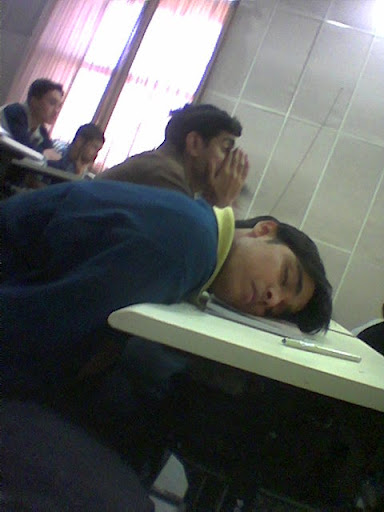 In this recent article in The Australian, Jim Barber (Vice Chancellor of UNE) suggests that universities are quickly becoming irrelevant, particularly those that don't understand that there is now no reason for students to attend traditional "lectures".
As I have said previously, universities have to find new ways to deliver value to students, delivering an experience that they can't obtain from Wikipedia. As Jim Barber argues, we should be building more places to hang out (informal learning spaces), as opposed to big empty lecture theatres.
Wednesday, November 11, 2009
In the Hotseat!
I want this...
More information about Hotseat is available from the Purdue University website.
What do you think?
Thursday, October 15, 2009
Is Twitter useful in education?

Earlier this semester I decided to add a Twitter widget to my Blackboard site, after an enthusiastic student began tweeting during one of my first-year lectures. I saw this as a great oppotunity to engage the students - beginning conversations during the class, and continuing them throughout the week.
At first, I would often display the widget on screen during the lecture, and discuss any tweets as they came through. But after a while the tweets slowed down. There were only half a dozen or so eager students using the service, and the novelty of this tool soon died.
Maybe I was just too early with this trial. Are there enough users of Twitter amongst our undergraduate student population yet?
Have you used Twitter in your teaching or learning? Do you think it could be a good educational tool? Let me know your thoughts in the comments below.
At first, I would often display the widget on screen during the lecture, and discuss any tweets as they came through. But after a while the tweets slowed down. There were only half a dozen or so eager students using the service, and the novelty of this tool soon died.
Maybe I was just too early with this trial. Are there enough users of Twitter amongst our undergraduate student population yet?
Have you used Twitter in your teaching or learning? Do you think it could be a good educational tool? Let me know your thoughts in the comments below.
Tuesday, October 6, 2009
Google Wave has arrived...
... well, for some people it has. I'm still waiting for my invitation!
Google Wave is going to be brilliant for teaching and learning. Here's why:
- It's designed for collaboration - good teaching practice encourages learners to work together.
- Conversations (waves) are place and time independent - you can invite new participants into a wave at any time, and they can replay the conversation to "catch up". Flexible learning (time and place) will be well-supported!
- It will grow - Google will allow third-party developers to extend Wave beyond its initial design. After personally experiencing the power of open source educational tools (such as Moodle), I am convinced that innovative educators will find amazing ways to build learning experiences in Wave.
- And most importantly, it takes the best Web 2.0 tools and combines them together into one application: wikis, multimedia, email, instant messaging, online applications, and more.
Here's a great little video from the creative team at epipheo studios explaining how Google Wave will change the way that we communicate online...
So, what do you think? Will it help you to teach or learn?
(And can somebody please send me an invitation?)
UPDATE (10 November 2009): I'm now on Wave (thanks Sid)! Add (and ping) me if you want to explore: peter.wagstaff@googlewave.com
Monday, October 5, 2009
Exams on PC?
When was the last time you wrote the "old-fashioned" way - pen and paper - for three hours straight?
Think about that last big report, academic paper, or letter that you wrote, and it's likely that it all happened on a keyboard and screen, not on paper. And the younger you are, the less likely you hand-write much these days - except for exams! We still expect our students to do something very unnatural when it comes time to sit an exam - up to three hours of handwriting. But that looks like changing...
The NSW Board of Studies has indicated that, by 2012, computers will be used in exams. This gives us three years to work out some of the complex issues that are inevitable with such a change - cheating, collusion, and invigilation to name a few.
So, is this a good idea, or do you mourn the loss of an important skill - the ability to use a traditional writing implement? What do you think?

Think about that last big report, academic paper, or letter that you wrote, and it's likely that it all happened on a keyboard and screen, not on paper. And the younger you are, the less likely you hand-write much these days - except for exams! We still expect our students to do something very unnatural when it comes time to sit an exam - up to three hours of handwriting. But that looks like changing...
The NSW Board of Studies has indicated that, by 2012, computers will be used in exams. This gives us three years to work out some of the complex issues that are inevitable with such a change - cheating, collusion, and invigilation to name a few.
So, is this a good idea, or do you mourn the loss of an important skill - the ability to use a traditional writing implement? What do you think?
Good Practice Principle #1 - Student-faculty contact
Do you spend time getting to know your students? Not only their names, but their interests and opinions? And do they get to know you?
One of the dangers of some online education is that it can distance the learner from the teacher, not only geographically, but personally. Recently I was chatting with a colleague, who teaches a large number of students in an off-campus unit. She made the comment that her online students often address her as "Mr", even at the end of a 13-week semester, as they have never met, never seen her, and never got to know her (she has a gender-neutral name). It's certainly not her fault, rather the traditional distance education systems that we are forced to use (Blackboard is one of the culprits!).
 The online experience doesn't have to be de-humanising. Consider the following Web 2.0 tools that can be used to connect with students:
One of the dangers of some online education is that it can distance the learner from the teacher, not only geographically, but personally. Recently I was chatting with a colleague, who teaches a large number of students in an off-campus unit. She made the comment that her online students often address her as "Mr", even at the end of a 13-week semester, as they have never met, never seen her, and never got to know her (she has a gender-neutral name). It's certainly not her fault, rather the traditional distance education systems that we are forced to use (Blackboard is one of the culprits!).
 The online experience doesn't have to be de-humanising. Consider the following Web 2.0 tools that can be used to connect with students:
- Video
- Skype
- Blogging (both as a blogger and as a commenter on student blogs)
I use all of these tools in my teaching, and they work brilliantly. There are benefits for me (getting to know my students), and for my students (increased connection to their teacher, and their learning experience).
I guess that's why it's called "social media"!
Sunday, October 4, 2009
Tag Galaxy (thing #6)

A quick post to highlight one of my favourite Flickr mashups, Tag Galaxy. It's a highly engaging, graphical interface for searching for images on Flickr using the visual metaphor of a "galaxy" of planets.
Searching for images has never been so much fun!
Monday, September 28, 2009
Ignorant rules (thing #5)

I await the day when our IT administrators accept the fact that "audio" and "video" are valid media for teaching and learning. The ignorant assumption that "multimedia equals illegal file sharing" has to be changed - quickly!
Thursday, September 24, 2009
Web 2.0 - Students' perspective
As part of the eMarketing unit that I teach, I offered students the opportunity to create an instructional video as part of their assessment. We've been exploring the evolution of the web, so Rick and James created this video, which they also have embedded on their new webpage, with links and references.
I plan to extend my use of video in student assessment over the coming years. Our students are becoming more proficient at creating multimedia work like this, and the process of doing so enhances their understanding of the concepts and theories they are studying.
Have you ever explored the use of student-created video in your teaching? Do you think that it's a good way for our students to learn?
I plan to extend my use of video in student assessment over the coming years. Our students are becoming more proficient at creating multimedia work like this, and the process of doing so enhances their understanding of the concepts and theories they are studying.
Have you ever explored the use of student-created video in your teaching? Do you think that it's a good way for our students to learn?
Tuesday, September 22, 2009
23 Things
Earlier this year I suggested that our Department run a "23 Things" program - an online self-directed exploration of Web 2.0 tools. Last week we commenced the program, and now, with a team of colleagues, we are exploring social media and how it can be used in teaching and learning.
Over the next couple of months, I'll be using this blog to share some aspects of my journey. I hope you enjoy it!
Over the next couple of months, I'll be using this blog to share some aspects of my journey. I hope you enjoy it!
Thursday, March 12, 2009
I'm still here!
A quick post to explain the lack of action here recently. The 2009 teaching year has commenced, and I've been so busy that I haven't found time to keep this blog up-to-date.

With 550 new first-year students enrolled in my Marketing unit, combined with my goal of producing three (1, 2, 3) podcast programs and a new video series each week, it hasn't been possible to dedicate time to keep RenewEd going.
But please stay tuned - I'll be back soon with more EduBlog goodness!
Cheers,
Wags.
Wags.
Thursday, February 19, 2009
Web 2.0's Seven Principles for Good Practice
Twenty-two years ago, well before we were using the internet for teaching and learning, Arthur Chickering and Zelda Gamson compiled a list of Seven Principles for Good Practice in Undergraduate Education. A copy of this list lived on the corkboard above my desk for the first few years that I was teaching. Although the corkboard is long gone, the list is still as important to me now as it was back then.

Over the next few weeks, I'll be discussing how these seven principles are still relevant today, and how Web 2.0 applications embedded into our teaching can help us to improve the outcomes for our students.
Subscribe to:
Posts (Atom)